The SEC Marketing Rule decides what an investment adviser can say in its marketing, and how. It covers your website, your LinkedIn posts, your client reviews and every performance chart. It also lets you do things the old rules banned, like using testimonials. If you market a wealth firm, this is the rulebook you’re playing by.
This guide is part of our wealth management marketing guide. It explains the rule in plain English: what counts as an advertisement, the seven general prohibitions, testimonials and ratings, performance, and where examiners keep finding problems. It isn’t legal advice. Use it to have a faster, better conversation with your chief compliance officer.
What the SEC Marketing Rule is and who it applies to
The Marketing Rule is Rule 206(4)-1 under the Investment Advisers Act of 1940. It replaced two older rules, the advertising rule and the cash solicitation rule, with one framework. It took effect on May 4, 2021, and firms had to comply by November 4, 2022 (SEC compliance guide).
It applies to SEC-registered investment advisers. Smaller, state-registered RIAs follow their state’s advertising rules instead, which often draw on the same ideas, so check with your state regulator.
What counts as an “advertisement”
The rule has a two-part definition:
- Any communication that offers your advisory services to prospective clients or private fund investors, or offers new services to current clients. That includes your website, emails sent to many people, social posts, videos, webinars and pitch books.
- Any paid testimonial or endorsement, whether you pay in cash or in kind (for example, reduced fees or gifts).
Some things are excluded: one-on-one communications (with an exception for hypothetical performance), live, unscripted oral communications, and information in required regulatory filings.
The seven general prohibitions
Every advertisement must avoid these seven problems. Most marketing issues trace back to one of them:
- Untrue statements of material fact, or leaving out facts that make a statement misleading.
- Material claims you can’t back up if the SEC asks for proof.
- Information that creates a misleading implication.
- Talking about benefits without fair and balanced treatment of the risks.
- Mentioning specific investment advice in a way that isn’t fair and balanced.
- Including or excluding performance, or choosing time periods, in a way that isn’t fair and balanced.
- Anything else that’s materially misleading.
In practice, that means every claim on your website needs evidence on file. “Award-winning,” “top-rated” and “we’ve helped hundreds of families” all need supporting records. “We help Seattle tech executives manage equity compensation” is a description of your services and much lower risk.
A pre-publish checklist for wealth firm marketing
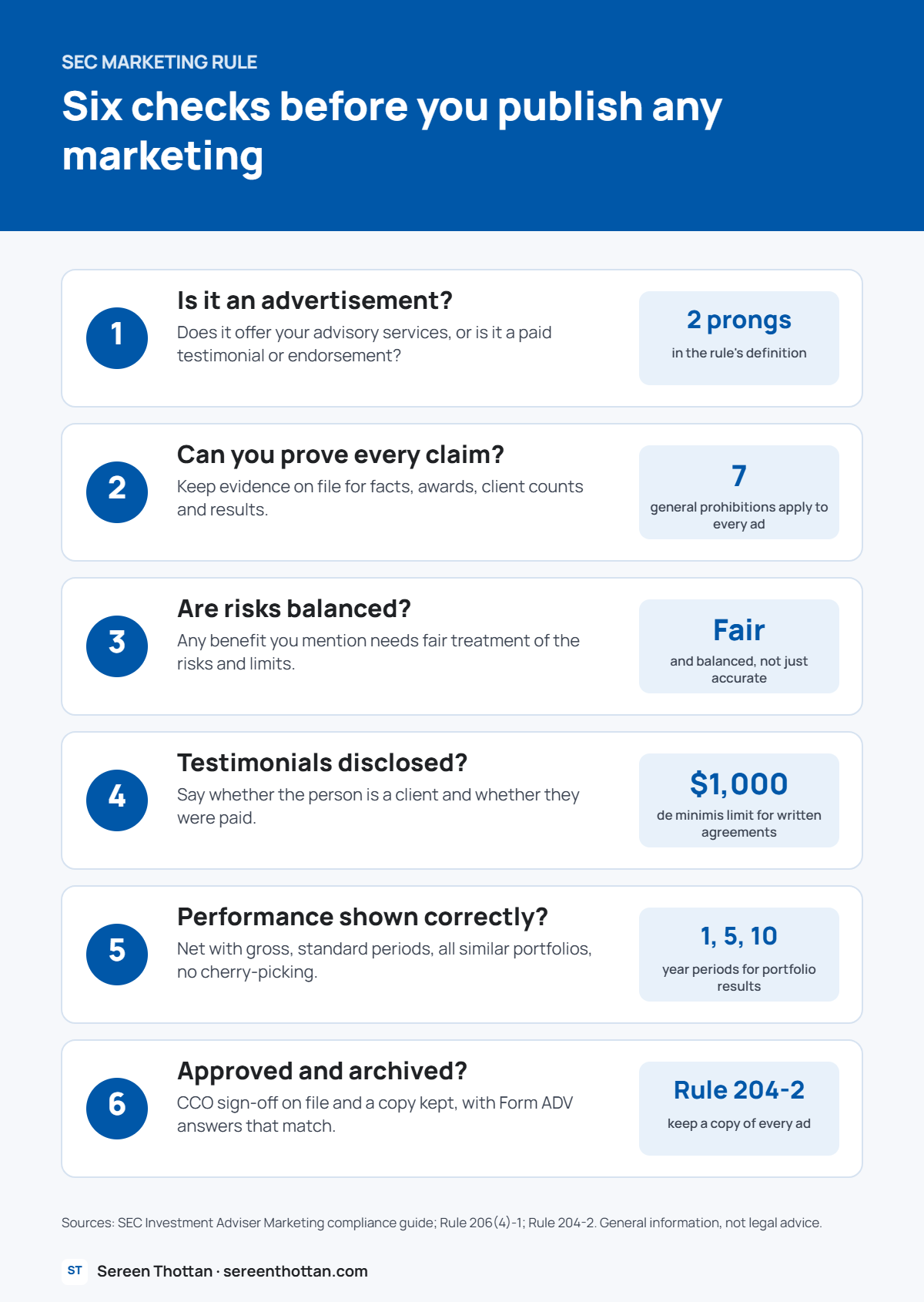
Run every new page, post, video and email through these six checks before it goes live. Most firms build them into a short approval form that the marketing team fills in and the CCO signs off.
Testimonials, endorsements and reviews
For the first time, the rule lets advisers use testimonials (from clients) and endorsements (from non-clients). That opened the door to Google reviews, client stories and referral programs, but with conditions:
- Disclosures. Clearly and prominently state whether the person is a client and whether they were paid, plus any material conflicts.
- Oversight. You need a reasonable basis to believe the testimonial or endorsement complies with the rule.
- Written agreements. Paid promoters need a written agreement, unless they’re affiliates or receive $1,000 or less in the past 12 months.
- Ineligible persons. Certain people with disciplinary histories can’t be paid promoters.
Two practical traps catch firms. First, cherry-picking: showing only five-star reviews, or quoting only the positive part. Second, adoption and entanglement: if you help write or edit someone else’s content, or share and endorse it, it can become your advertisement. That applies on social media too, which we cover in our compliance-safe LinkedIn playbook for financial advisors.
Third-party ratings and awards
“Top advisor” lists and awards are allowed if the rating meets the rule’s conditions and you disclose key facts: the date of the rating, the period it covers, who gave it and whether you paid anything to be considered or to use it. If the rating came from a survey, you need a reasonable basis to believe the survey let participants give both favorable and unfavorable answers. Paid-for awards with the payment hidden are one of the most common findings in exams.
Performance advertising
Performance is the most technical part of the rule. The key requirements for an advertisement are:
- Net with gross. You can’t show gross performance without net performance next to it.
- Standard time periods. Portfolio performance generally needs to cover one-, five- and 10-year periods (or the life of the portfolio if shorter).
- No cherry-picking. Show results for all substantially similar portfolios, not just the best ones.
- Extracted performance. Results for a subset of a portfolio need the total portfolio’s results alongside or promptly available.
- Hypothetical performance. Model, backtested and projected returns are allowed only with policies that make sure they’re relevant to the audience’s financial situation, plus the information needed to understand them.
- Predecessor performance. Results from a prior firm need similar people and accounts and clear disclosures.
- No SEC endorsement. Never say or imply the SEC approved or reviewed your figures.
The SEC staff keeps adding detail through its Marketing Rule FAQ. In March 2025 it clarified when gross-only extracted performance and portfolio characteristics can be shown, and in January 2026 it said net performance based on actual fees isn’t automatically prohibited. If your firm shows performance anywhere, ask your CCO to check the latest FAQ.
For most RIAs marketing to individual families, the simplest path is to keep performance off the public website altogether and focus on who you serve and how you work.
Where examiners keep finding problems
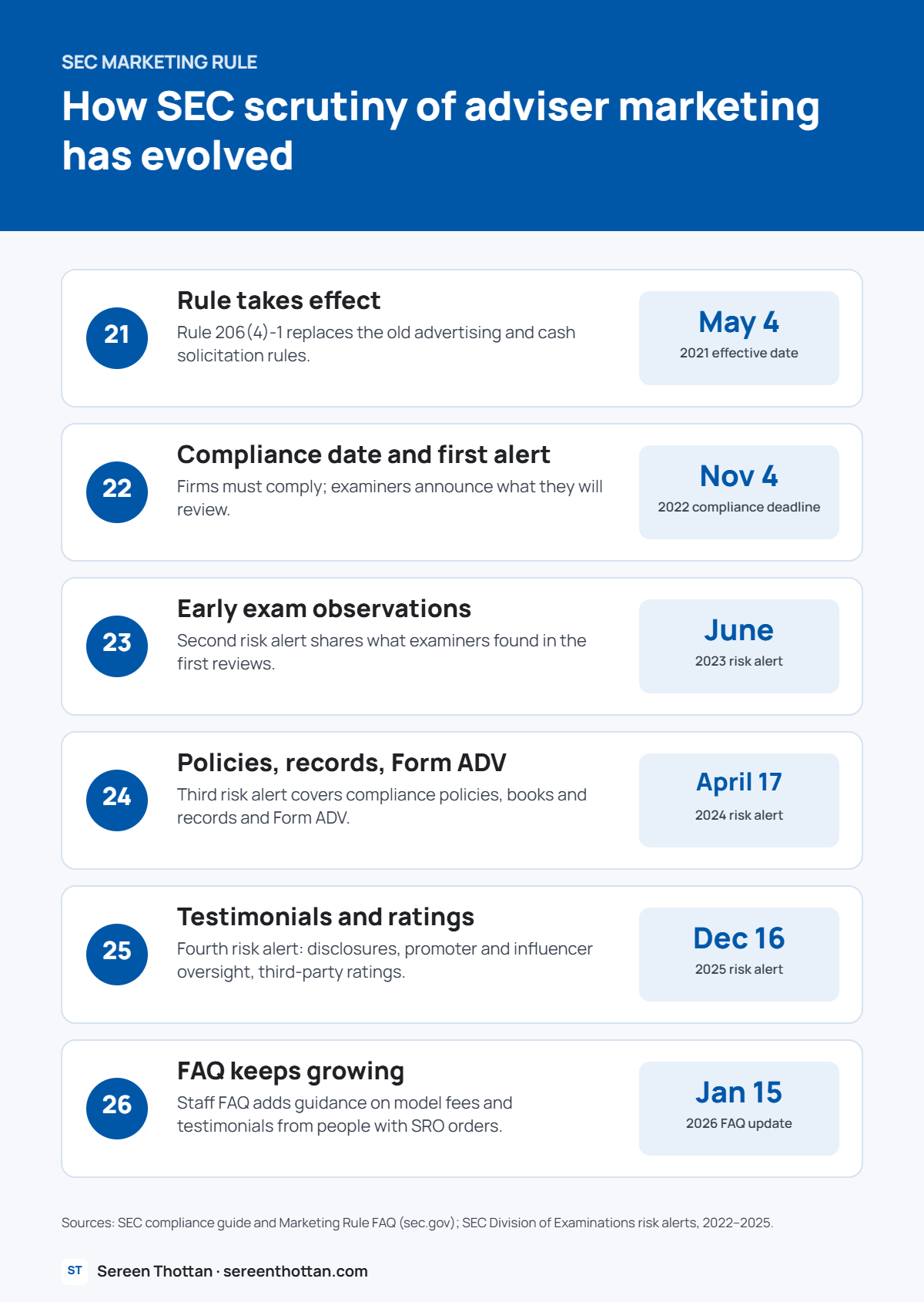
The SEC’s Division of Examinations has published four risk alerts on the Marketing Rule since 2022. The most recent, on December 16, 2025, focused on testimonials, endorsements and third-party ratings. Examiners found missing or vague disclosures, weak oversight of promoters and social media influencers, and firms that couldn’t show a reasonable basis for believing their testimonials complied with the rule.
The common thread across the alerts is that policies on paper aren’t enough. Examiners want to see that firms actually reviewed advertisements, kept records and followed their own procedures. Enforcement has followed: the SEC has settled charges with dozens of advisers over Marketing Rule violations, many involving hypothetical performance shown on public websites.
Recordkeeping and Form ADV
The rule comes with two administrative duties that are easy to forget:
- Books and records (Rule 204-2). Keep a copy of every advertisement you disseminate, plus the records behind performance, testimonials, endorsements and third-party ratings. That includes old versions of your website and archived social posts.
- Form ADV. Item 5.L asks about your marketing practices, such as whether you use performance, testimonials, endorsements or third-party ratings. Your answers need to match what’s actually on your website.
How to market well inside the rule
The rule rewards the same things that make marketing work: clarity, specifics and proof. A few habits keep both your CCO and your prospects happy:
- Lead with who you serve. Niche positioning (“wealth management for physicians in Dallas”) is low risk and high impact.
- Teach, don’t promise. Educational articles that answer real client questions rarely raise compliance issues and are what Google and AI tools reward. See how ChatGPT decides which wealth manager to recommend.
- Publish fees and minimums. It’s factual, it helps prospects self-qualify and it’s what wealthy families look for, as we explain in how to market to high-net-worth clients.
- Use reviews carefully. If you show reviews, show them all with the required disclosures, and document how you collected them.
- Build a review workflow. A one-page approval form, an archive and a quarterly check of your website against Form ADV prevent most problems.
If you want compliant content produced to that standard, see our content service for financial advisors.
Go deeper
- Wealth Management Marketing: The 2027 Guide
- How to Market to High-Net-Worth Clients
- How ChatGPT Decides Which Wealth Manager to Recommend
- LinkedIn for Financial Advisors: A Compliance-Safe Playbook
SEC Marketing Rule FAQ
What is the SEC Marketing Rule?
The SEC Marketing Rule (Rule 206(4)-1 under the Investment Advisers Act) governs advertisements by SEC-registered investment advisers. It sets seven general prohibitions and specific conditions for testimonials, endorsements, third-party ratings and performance. Firms have had to comply since November 4, 2022.
Can financial advisors use client testimonials and reviews?
Yes. Since the Marketing Rule took effect, SEC-registered advisers can use testimonials and endorsements, including online reviews, if they clearly disclose whether the person is a client and whether they were paid, oversee compliance and have written agreements with paid promoters where required. Showing only positive reviews can be misleading.
Does the Marketing Rule apply to my website and social media?
Yes. Any communication that offers your advisory services to prospective clients can be an advertisement, including your website, social media posts, videos and mass emails. One-on-one communications and live, unscripted conversations are generally excluded.
Can I show performance on my website?
You can, but strict conditions apply: net performance alongside gross, one-, five- and 10-year periods, all substantially similar portfolios and extra policies for hypothetical performance. Many RIAs leave performance off their public websites to avoid the risk.
Does the SEC Marketing Rule apply to state-registered RIAs?
No. The rule applies to SEC-registered advisers. State-registered advisers follow their state’s advertising rules, which vary, so check with your state securities regulator.
Want marketing that wins clients and passes review? Get a free AI Visibility Snapshot and see how your firm shows up in ChatGPT, Perplexity and Google’s AI Overviews today. Get my Snapshot →
This article is for general information and isn’t legal or compliance advice. Confirm any marketing changes with your CCO.