ChatGPT recommends wealth managers it can clearly identify, verify across several trusted sources, and match to the exact question being asked. Firms with specific, consistent, well-cited information about who they serve get named. Firms with vague “we provide holistic wealth solutions” websites usually don’t.
AI recommendations are now one part of a wider picture. For the full strategy, see our guide to wealth management marketing in 2027.
That matters more every quarter. In a 2025 Wealthtender survey of 500 US households earning over $100,000 and planning to hire an advisor, one in four said they would use AI tools like ChatGPT or Gemini to start their search. And prospects who arrive by referral increasingly ask AI about the firm they were referred to before they call.
Here’s what happens behind the answer, and what your firm can do about it.
What happens when a prospect asks AI for an advisor
Say a prospect types: “Who’s the best fee-only fiduciary advisor in Seattle for a tech executive with a lot of company stock?”
Tools like ChatGPT search, Perplexity and Google’s AI Overviews don’t rely only on what the model learned in training. They run live searches, pull a set of web pages they consider trustworthy, and write an answer from those pages, often naming two to four firms and citing where the information came from.
So the question isn’t “Does ChatGPT like us?” It’s three simpler questions:
- Can the AI find pages about us that answer this question?
- Do other trusted sources say the same thing about us?
- Is it clear we’re a fit for this specific person?
A traditional search result gave every firm on page one a chance. An AI answer names a handful. If you’re not in it, the prospect may never see you.
6 signals that get a wealth firm recommended
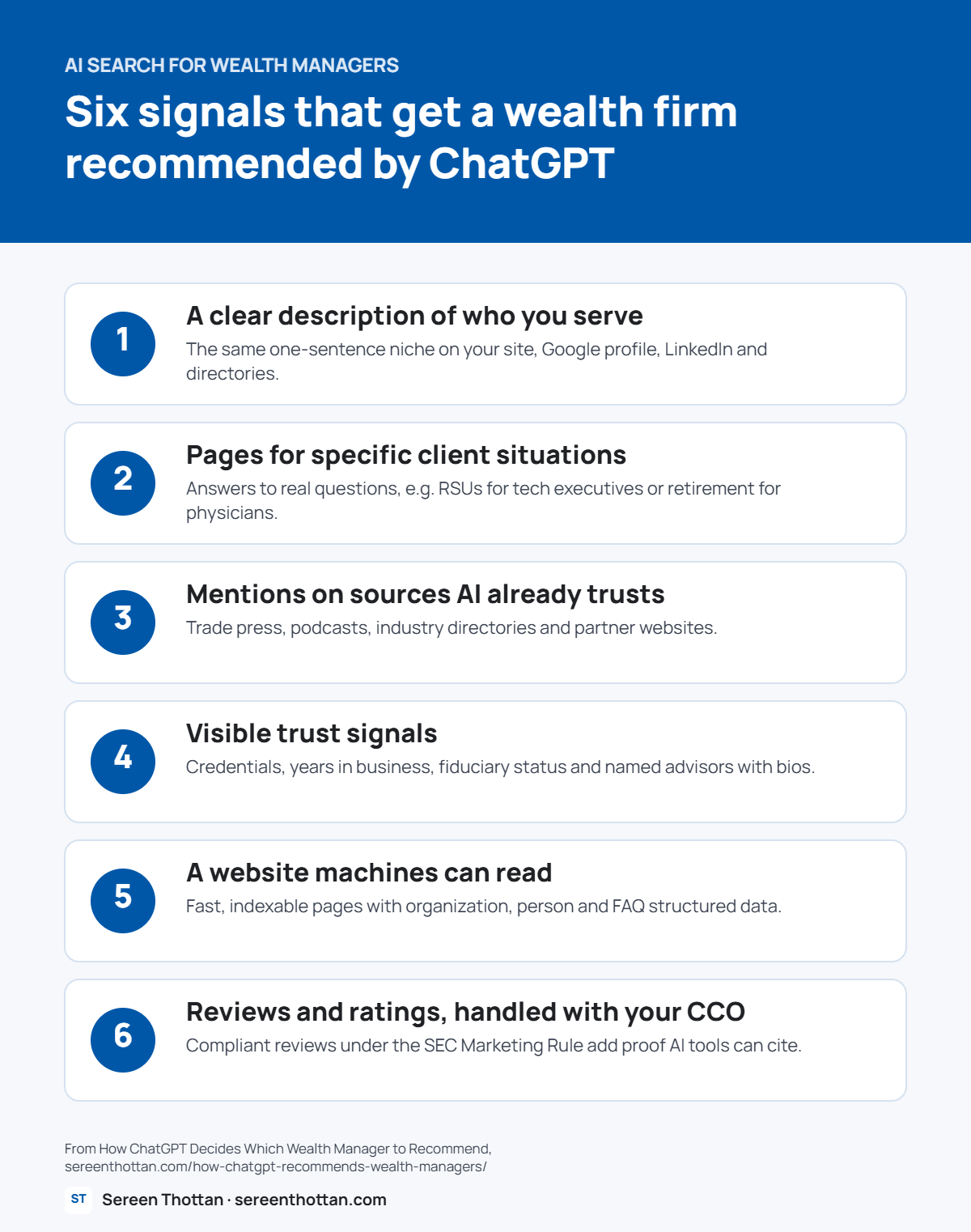
1. A clear, consistent description of who you serve
AI tools look for an unambiguous “entity”: your firm name, location, fee structure, who you serve and what you specialize in. If your homepage says “comprehensive wealth management for discerning families” and your LinkedIn says “retirement planning”, the AI has nothing specific to match.
Write one sentence and repeat it everywhere: website, Google Business Profile, LinkedIn, directory listings and advisor bios. For example: “[Firm] is a fee-only fiduciary RIA in Bellevue, Washington, serving technology executives and their families with equity compensation, tax and retirement planning.”
2. Pages that answer specific client situations
The prompts that matter are specific: business owners selling a company, physicians with high income and debt, executives with RSUs and ISOs, widows managing a new estate. A single “Services” page can’t answer all of those.
Create one answer-first page per core client type. Open each with a two-sentence direct answer, then explain how you help, what’s typical, and who it’s not for. These pages are what AI tools quote.
3. Mentions on sources the AI already trusts
AI answers lean on third-party sources: local business journals, industry publications, podcast show notes, “top advisor” lists, CPA and estate attorney partner pages, and advisor directories. If those sources mention you in connection with your niche and city, you’re far more likely to appear.
A practical start: list the five sites that show up when you ask Perplexity your ideal client’s question, and work out how to earn a mention on each.
4. Visible trust signals
Google classes financial content as “Your Money or Your Life” and holds it to a higher standard. The same signals help AI engines: named advisors with credentials (CFP®, CFA), a link to your Form ADV, clear disclosures, physical office address, and author bios on every article.
5. A website machines can read
If your site is slow, built mostly from images, or blocks search crawlers, AI tools may never see your best content. Check that your robots.txt doesn’t accidentally block the crawlers you want, add structured data (schema) for your organization, advisors, services and FAQs, and keep key facts in plain HTML text, not inside images or PDFs.
6. Reviews and ratings, handled with your CCO
AI answers often summarize reviews. Under the SEC Marketing Rule, testimonials and third-party ratings come with conditions, so how you collect and show them is a compliance decision. Agree an approach with your CCO before you start asking clients for reviews.
How to check if AI recommends your firm today
Open ChatGPT, Perplexity, Gemini and Google (look for the AI Overview) and ask 10 questions your ideal clients would ask. Mix three types:
- Category + city: “Best fee-only financial advisor in Greenwich, CT”
- Situation + city: “Wealth manager in San Jose for a startup founder after an acquisition”
- Your name: “Is [your firm] a good fit for a retiring physician?”
Note for each: are you named, who is named instead, and which sources are cited. Patterns show up quickly. [YOUR EXAMPLE: one anonymised finding from a recent check]
What to do this quarter
- Write your one-sentence firm description and update it everywhere.
- Publish one answer-first page for your most valuable client type.
- Claim and complete your Google Business Profile.
- Pick three trusted third-party sources and pursue a mention on each.
- Re-run your 10 questions every month and track the change.
FAQ
Can I pay to appear in ChatGPT’s recommendations?
Not in the way you’d buy a search ad. Appearing depends on what trusted sources say about your firm.
How long does it take to start appearing in AI answers?
Fixes to your own site and Google Business Profile can show up within weeks. Earning third-party mentions and consistent recommendations usually takes three to six months.
Is this different from SEO?
It builds on SEO. Optimizing for AI answers is often called GEO (Generative Engine Optimization) or AEO (Answer Engine Optimization). The foundations are the same: a trustworthy, clear, well-structured site that others link to and mention.
Want to know if AI recommends your firm right now? I’ll test 10 questions your ideal clients ask across ChatGPT, Perplexity, Gemini and Google AI Overviews and send you a one-page grid of where you appear, and who appears instead. Get your free AI Visibility Snapshot →
This article is for general information and isn’t legal or compliance advice. Confirm any marketing changes with your CCO.