LinkedIn for financial advisors works best as a trust channel, not a lead machine. Most advisors who post on LinkedIn never sign a client directly from a post. The ones who get value from it use LinkedIn to stay visible to centers of influence, make referrals easier to act on and send people back to a website that does the selling. They also do it inside the compliance rules, so nothing they post becomes a problem in an SEC exam.
This playbook is part of our guide to digital marketing for RIAs, which compares every channel by what it costs to win a client. Here we go deep on one: what the 2026 data says about LinkedIn, which rules apply and a step-by-step system you can run with your chief compliance officer.
Does LinkedIn work for financial advisors? What the 2026 data says
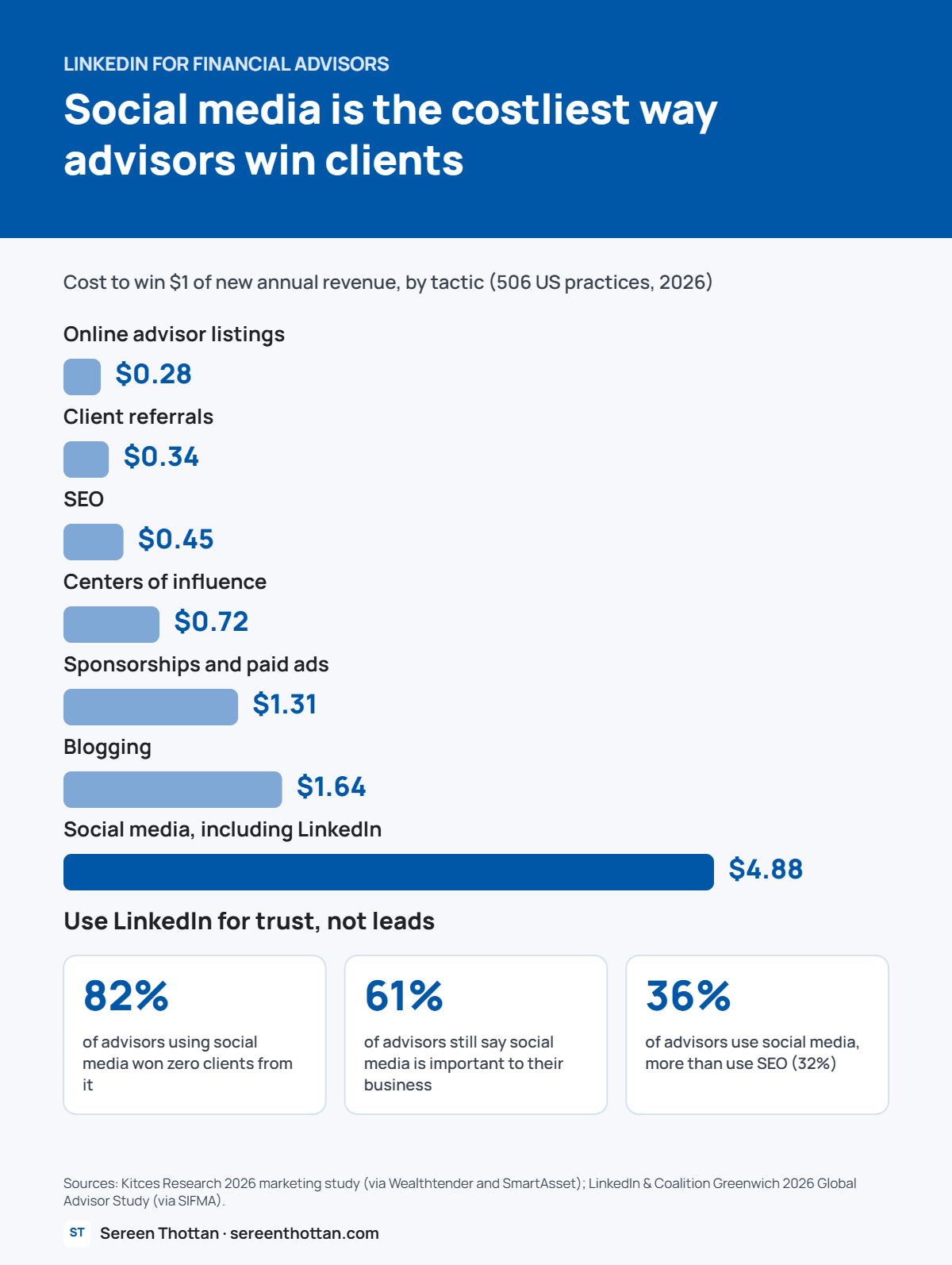
Advisors like social media more than social media likes them back. In LinkedIn’s 2026 Global Advisor Study with Coalition Greenwich, which surveyed 1,551 advisors in 10 countries, 61% said social media is important to their business (SIFMA). Over 60% follow their clients on social media.
The results tell a different story. The Kitces Research 2026 marketing study, which tracked what 506 advisory practices spend to win new revenue, found social media was the least efficient tactic it measured:
- Social media cost $4.88 to win $1 of new annual revenue, compared with $0.45 for SEO and $0.28 for online advisor listings.
- 82% of advisors who used social media got zero new clients from it in the past year.
- About 36% of advisors use social media for marketing, more than use SEO (32%) or blogging (27%).
(Sources: Kitces Research via Wealthtender; SmartAsset’s summary of the same study.)
That doesn’t mean LinkedIn is a waste of time. It means it does a different job. LinkedIn is where a CPA, an estate attorney or a referred prospect checks you out, and where you stay top of mind with the professionals who send you clients. Judge it on that job, not on likes.
The compliance rules that apply to LinkedIn
Before anyone on your team posts, agree how these rules apply to your firm. None of this is legal advice; your CCO has the final word.
The SEC Marketing Rule
For SEC-registered RIAs, the SEC Marketing Rule (Rule 206(4)-1) applies to any communication that offers your advisory services to prospective clients. A LinkedIn profile, a company page and a post that promotes your services can all count as advertisements. Three parts matter most on LinkedIn:
- General prohibitions. No misleading statements, no claims you can’t back up on request and no benefits without a fair mention of risks.
- Testimonials and endorsements. They’re allowed with clear disclosures, oversight and, for paid promoters, a written agreement. Many compliance teams treat LinkedIn recommendations and skill endorsements from clients as testimonials, so decide whether to allow, disclose or hide them.
- Adoption and entanglement. You can become responsible for someone else’s content if you help prepare it (entanglement) or explicitly or implicitly approve it (adoption). Sharing a client’s glowing post about you, or editing comments to show only positive ones, can cross that line.
Recordkeeping applies too. Advisers must keep copies of every advertisement they disseminate, so your posts, profile versions and any client messages about advice need to be archived. For the full rule beyond social media, see our plain-English guide to the SEC Marketing Rule.
FINRA rules for dually registered advisors
If you’re also a registered representative, FINRA Rule 2210 adds its own layer. Today, static content such as your profile and posts generally needs a registered principal’s approval before use, while interactive content such as comments and real-time replies can be supervised after the fact. FINRA proposed changing this in Regulatory Notice 26-14 (July 2026), which would replace blanket pre-use approval with risk-based procedures and drop the static-versus-interactive split. It’s still a proposal, so follow the current rule and your broker-dealer’s policy.
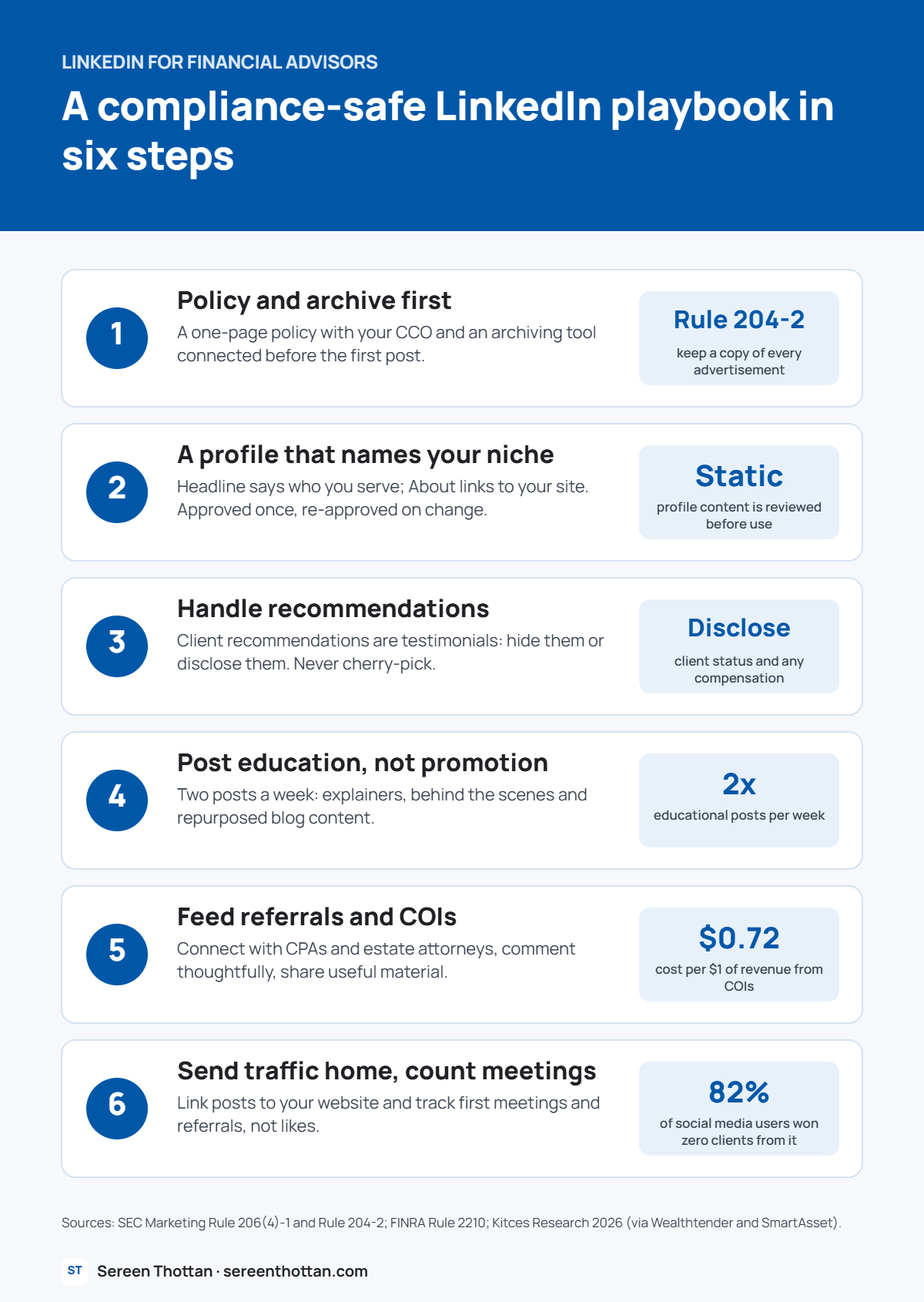
A compliance-safe LinkedIn playbook in six steps
1. Put the policy and archive in place first
Write a one-page LinkedIn policy with your CCO: who may post about the firm, what needs approval before it goes live, how comments and messages are handled and what gets archived. Connect LinkedIn to an archiving tool before the first post. This takes a week and saves you from an exam finding later.
2. Build a profile that names your niche
Your profile is static, approved content, and for most prospects it’s the first thing they see after your website. Use the headline to say who you serve (“Helping tech executives in Seattle manage equity compensation”), not just your title. Fill in the About section with your process, credentials and a link to your website. Ask compliance to approve it once and re-approve it when it changes.
3. Decide how you’ll handle recommendations and endorsements
Recommendations from clients are testimonials. Either hide them, or keep them with the disclosures your CCO requires (whether the person is a client and whether they were compensated). Don’t pick and choose which ones to show, and never ask clients to write them in exchange for anything.
4. Post education, not promotion
Educational posts are lower risk and more useful. Aim for two posts a week built from three types:
- Explainers: a short take on a question your niche asks (“What happens to RSUs when you leave a company?”).
- Behind the scenes: how your team works, without client details or results.
- Repurposed content: a key point from your latest blog post, with a link back to the full article.
Avoid performance figures, market predictions, product names and anything that reads like a recommendation. If you want help turning one article into a month of compliant posts, see our content service for financial advisors.
5. Use LinkedIn to feed referrals and centers of influence
This is where LinkedIn earns its keep. Connect with the CPAs, estate attorneys and business brokers who serve your niche, comment thoughtfully on their posts and share useful material they can pass to their clients. A short, personal message after a joint meeting does more than a dozen posts. Comments count as interactive content, so keep them educational too.
6. Send traffic to your website and measure meetings
Every useful post should point somewhere: an article, a guide or a booking page on your own site, where you control the message and can track the result. Measure LinkedIn by first meetings and referrals it helped start, not by followers. Our guide to lead generation for RIAs shows how to set up tracking from first click to booked call.
10 compliant LinkedIn post ideas for advisors
- A checklist for your niche’s most common decision (for example, the year before selling a business).
- A plain-English explainer of a rule change, such as new contribution limits for the coming year.
- Three questions to ask before hiring any financial advisor.
- A myth-versus-fact post about a topic your clients worry about.
- A short video answering one question you hear every week.
- A summary of a useful article from a reputable US source, with your take.
- Your team’s process for onboarding a new client, step by step.
- An invitation to a webinar or workshop you’re hosting with a CPA partner.
- A year-end planning reminder list.
- A link to your latest blog post with the single most useful takeaway.
Run each through your approval process before posting. Keep them general, educational and free of any promise about results.
LinkedIn mistakes that create compliance risk
- Liking or sharing client praise. It can turn their words into your testimonial.
- Editing or deleting only negative comments. Selective editing is a classic entanglement problem.
- Posting performance or “top advisor” claims without the required disclosures and supporting records.
- Discussing advice in direct messages that aren’t being archived.
- Letting staff post about the firm without training or a policy.
- Treating LinkedIn as your website. Your profile should send people to a site that ranks, explains and converts. That’s the job of SEO for RIAs.
Go deeper
- Digital Marketing for RIAs: The Complete Playbook
- Lead Generation for RIAs: From Google Search to Booked Meeting
- SEO for RIAs: A Practical Guide for Independent Wealth Firms
- How Much Should an RIA Spend on Marketing in 2027?
- How to Market to High-Net-Worth Clients
- The SEC Marketing Rule: A Plain-English Guide for Wealth Firms
LinkedIn for financial advisors FAQ
Is LinkedIn worth it for financial advisors?
Yes, as a credibility and relationship channel. As a direct source of clients it’s weak: in the Kitces 2026 study, social media cost $4.88 to win $1 of new revenue and 82% of advisors using it got no new clients from it. Use LinkedIn to support referrals and centers of influence, and send people to your website.
Can financial advisors get recommendations on LinkedIn?
Under the SEC Marketing Rule, recommendations from clients are generally treated as testimonials. They’re allowed with the required disclosures and oversight, but many firms hide them to keep things simple. Agree an approach with your CCO.
Do LinkedIn posts need compliance approval?
It depends on your registration and your firm’s policy. FINRA-registered representatives generally need principal approval for static content such as profiles and posts before use. SEC-registered RIAs must make sure posts that promote their services meet the Marketing Rule and are archived.
Do financial advisors have to archive LinkedIn posts?
Yes. Advisers must keep copies of every advertisement they disseminate, and business messages may also need to be kept. Most firms connect LinkedIn to an archiving tool before anyone posts.
How often should a financial advisor post on LinkedIn?
Two educational posts a week is a sustainable pace for most advisors. Consistency matters more than volume, and every post should go through your approval process.
Want LinkedIn and content working together? Book a 30-minute strategy call and we’ll map a compliant content plan that sends LinkedIn readers to a website that books meetings. Book a call →
This article is for general information and isn’t legal or compliance advice. Confirm any marketing changes with your CCO.