Marketing to high-net-worth individuals is about one thing: earning trust before the first meeting. A family with $5 million or more doesn’t pick a wealth manager from an ad. They hear a name from someone they trust, then check you quietly online, often more than once, before they ever pick up the phone. Your marketing has to work in both places: in the room where the referral happens and on the screen where they verify it.
This guide is part of our wealth management marketing guide. That pillar covers the full strategy. This post zooms in on one audience: high-net-worth (HNW) clients with $1 million to $30 million in investable assets, and what it takes to win them in 2027.
The high-net-worth market in 2027: what’s changed
There are more HNW households in the US than ever, and they’re easier to lose. Three findings from 2026 research set the scene:
- The market is growing fast. The US added 736,000 millionaires in 2025, the most of any country, taking its HNW population to 8.7 million (Capgemini World Wealth Report 2026). Capgemini counts anyone with $1 million or more in investable assets, excluding their primary residence.
- Loyalty is fading. In 2019, 39% of HNW investors worked with a single wealth firm. By 2025 that share had fallen to 19%. Only 17% describe their advisory experience as seamless and personalized, and 42% say they have to repeat their goals to the same firm more than once.
- Referrals aren’t the whole story. A 2026 survey of 1,000 advised investors by Ficomm Partners and Absolute Engagement found that 50% of investors with $5 million or more found their current advisor with no referral at all. Only 31% relied on a referral alone (InvestmentNews).
Put together, that means more wealthy prospects, shopping around more, and judging you on what they find for themselves.
What high-net-worth clients actually want from a wealth manager
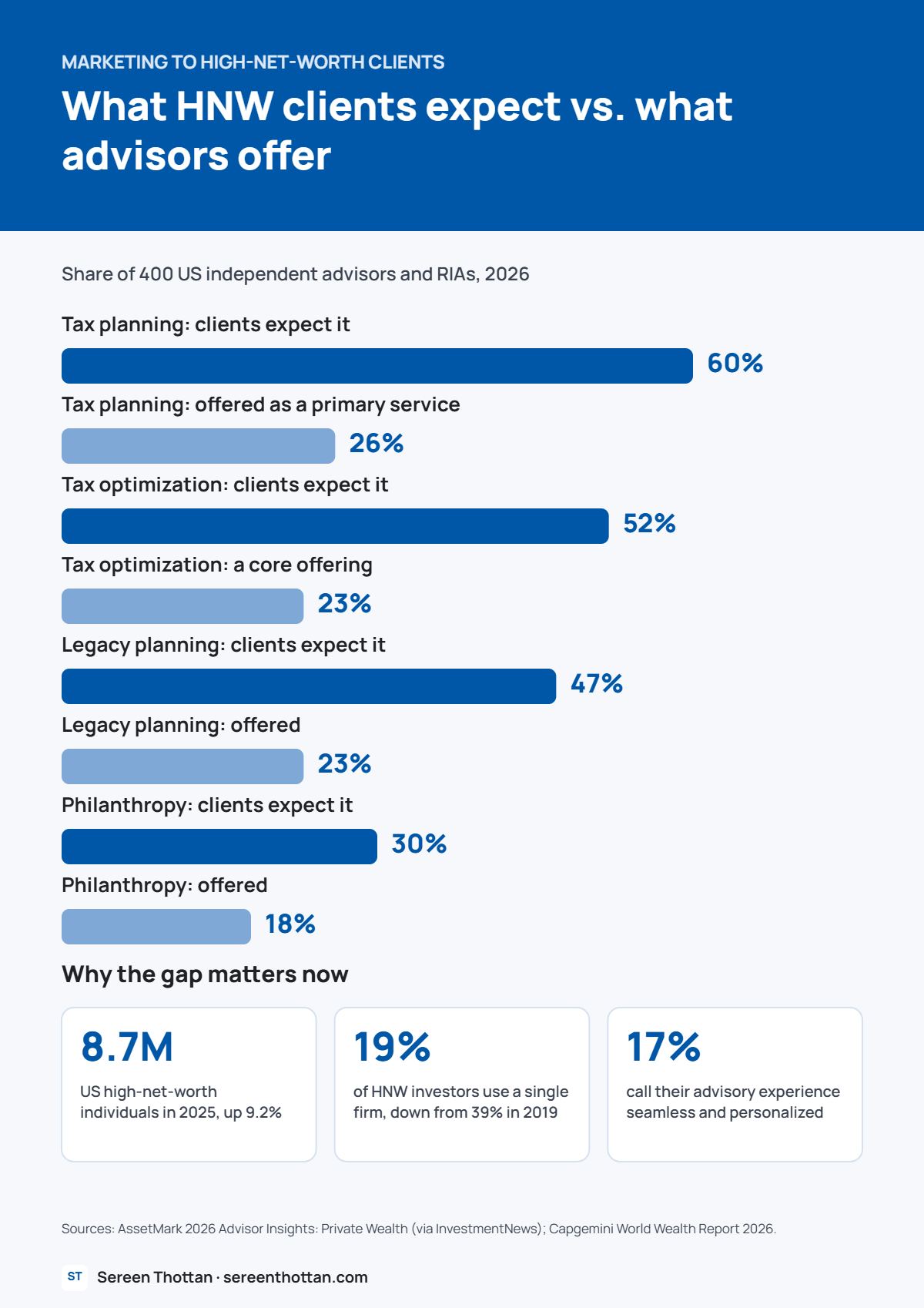
Wealthy clients don’t come to you for a portfolio alone. AssetMark’s 2026 survey of 400 independent advisors found that 90% say clients come to them for investment management, but 83% say clients also expect help with the rest of their financial lives. The gap shows up in the details:
- 60% of advisors say HNW clients expect tax planning, but only 26% offer it as a primary service.
- 52% say clients expect tax optimization; 23% make it a core offering.
- 47% say clients expect legacy planning; 23% offer it.
- 30% say clients expect help with philanthropy; 18% offer it.
(Source: AssetMark 2026 Advisor Insights via InvestmentNews.)
That gap is a marketing opportunity. If your firm does coordinate tax, estate and charitable planning, say so plainly and show how. If you work with outside CPAs and estate attorneys, explain how that works for the client. The firm that describes the full picture clearly will beat the firm that lists “comprehensive wealth management” and stops there.
How to market to high-net-worth clients: a six-step system
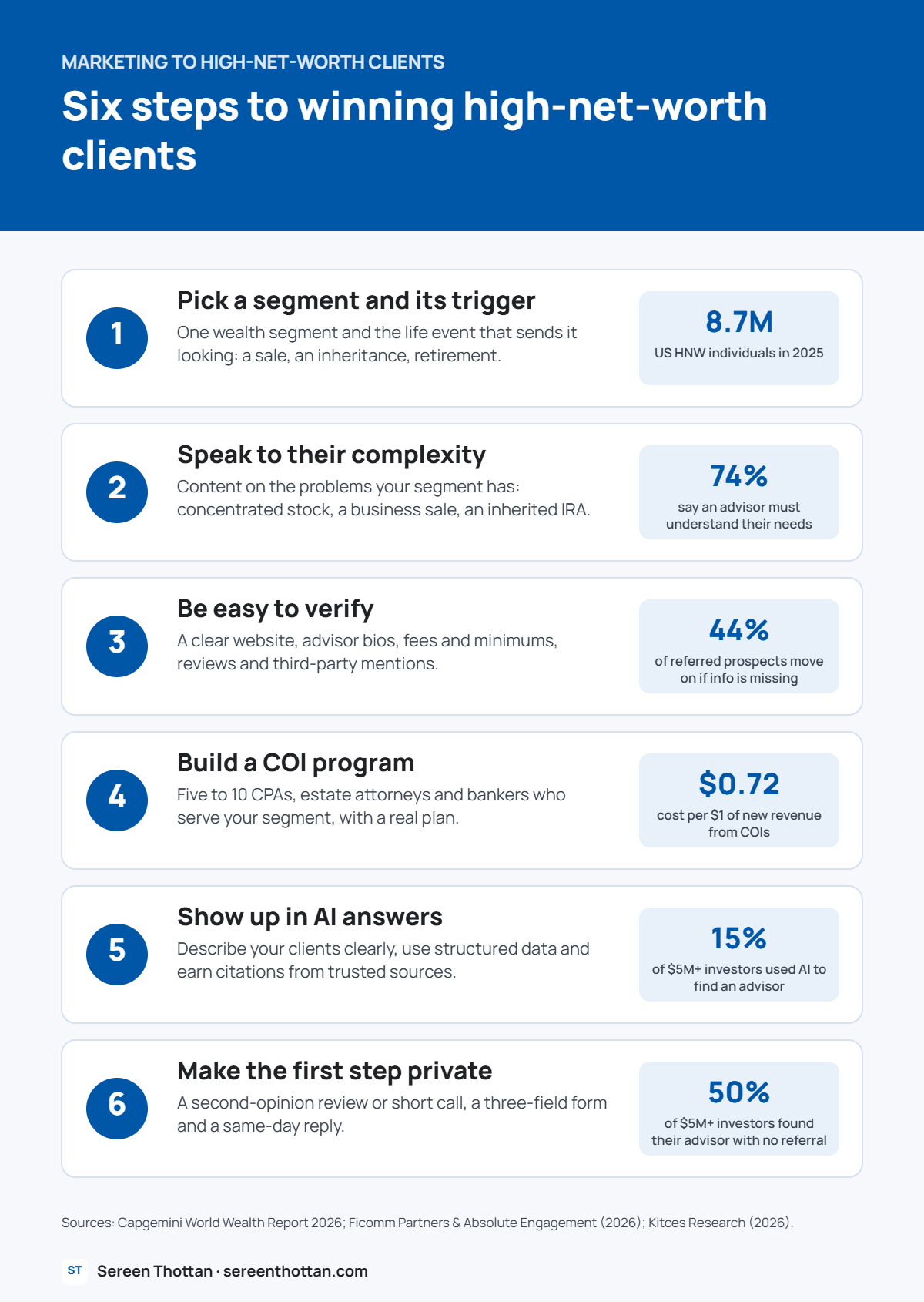
1. Pick one wealth segment and the moment it needs you
“High net worth” is too broad to market to. A tech executive in Seattle with concentrated stock, a business owner in Dallas planning a sale and a widow in Greenwich inheriting a family portfolio all have $5 million, and nothing else in common. Pick one or two segments and the trigger events that send them looking: a liquidity event, an inheritance, a divorce, retirement, a move or a new baby. A Dynasty Financial Partners survey of HNW investors found that life events like these are what usually prompt wealthy families to contact an advisor, and many hire the first one they speak with. Your job is to be that first conversation.
2. Speak to their complexity, not your process
HNW prospects want proof you understand their situation. In the Ficomm study, 74% of investors said it was very important that an advisor understands their needs. Write pages and articles about the problems your segment has: “How to diversify a concentrated stock position,” “What to do in the year before you sell your business,” “Managing an inherited IRA under the 10-year rule.” These pages rank for searches your ideal clients run, and they read as evidence of expertise when a referral checks you out.
3. Make yourself easy to verify
Every referral ends with a search. The prospect types your name, your firm’s name or your advisor’s name into Google, and increasingly into ChatGPT. Kitces research found that 44% of referred prospects move on if they can’t find the information they need. Make sure a search for your name returns:
- A website that says who you serve, what you do and roughly what it costs (minimums and fee structure)
- Advisor bio pages with credentials, experience and a real photo
- A complete Google Business Profile and, where your compliance team approves, client reviews
- Third-party mentions: press quotes, podcast appearances, industry awards and directory listings
This is where SEO for wealth managers earns its keep. It’s not about ranking for “financial advisor near me.” It’s about controlling what a wealthy prospect sees when they look you up.
4. Build a center-of-influence program
CPAs, estate attorneys, business brokers and private bankers see wealth events before anyone else. Treat these relationships as a marketing channel with a plan: pick five to 10 professionals who serve your segment, share useful content they can pass on, co-host a small event or webinar and follow up on every introduction within a day. Kitces found centers of influence cost about $0.72 to win $1 of new annual revenue, which makes them one of the more efficient channels for HNW firms.
5. Show up in AI answers
AI is now part of how wealthy people research advisors. About 9% of all investors in the Ficomm study used a tool like ChatGPT, Gemini or Claude to find an advisor, and 15% of those with $5 million or more did. AI tools tend to recommend firms that describe their clients clearly, use structured data and are cited by trusted third parties. We explain the signals in detail in How ChatGPT Decides Which Wealth Manager to Recommend.
6. Make the first step private and low-risk
Wealthy prospects value discretion. A form that asks for assets, phone number and date of birth before they’ve spoken to anyone will lose them. Offer a smaller first step instead: a second-opinion portfolio review, a short call about a specific decision, or a planning checklist for their trigger event. Keep the form to three fields, reply the same day and make the booking link work on a phone.
Channels that reach wealthy clients (and the ones that don’t)
Not every channel suits an HNW audience. Here’s how the main ones compare for firms focused on wealthy families:
- Referrals and centers of influence: Still the biggest source of HNW clients. Strengthen them with a website and content that make the referral easy to act on.
- SEO and niche content: Strong for segment-specific searches (“wealth manager for tech executives in Seattle”) and for supporting referrals. Slow to start, efficient once built.
- Small, curated events: Dinners, workshops for business owners or a tax-season briefing with a CPA partner work far better than large public seminars.
- Online listings and reviews: Low cost and worth having, mainly as credibility signals.
- LinkedIn: Useful for staying visible to centers of influence and executives, but rarely a direct source of HNW clients.
- Broad paid ads: Generally a poor fit. Wealthy prospects rarely click a generic ad, and the leads skew toward smaller accounts.
Keeping HNW marketing compliant
Testimonials, endorsements and case studies are powerful with wealthy prospects, and the SEC Marketing Rule allows SEC-registered advisers to use them with the right disclosures, oversight and recordkeeping. Performance claims, hypothetical returns and “top advisor” rankings carry extra requirements. Agree a review process with your chief compliance officer before you publish client stories, and keep records of every version. Wealthy families also care about privacy, so never share client details without written consent, even anonymized ones that could identify a family in a small community.
Common mistakes when marketing to the wealthy
- Trying to look exclusive by saying nothing. A vague, image-heavy website with “bespoke solutions” copy fails the verification search. Specific beats mysterious.
- Hiding fees and minimums. HNW prospects compare firms. If they can’t tell whether they fit, they move on.
- Talking only about investments. Your competitors are promising tax, estate and family coordination. Show what you do beyond the portfolio.
- Ignoring the next generation. Cerulli projects $124 trillion will change hands through 2048. Heirs research advisors online and through AI first.
- Measuring traffic instead of meetings. Track qualified conversations and new clients by source.
Go deeper
- Wealth Management Marketing: The 2027 Guide
- Family Office Marketing: How to Be Found by the Right Families
- How ChatGPT Decides Which Wealth Manager to Recommend
- Digital Marketing for RIAs: The Complete Playbook
Marketing to high-net-worth clients FAQ
How do you attract high-net-worth clients?
Focus on one wealth segment and the life events that send it looking for an advisor, then build trust where those prospects look: referrals, centers of influence, useful content and a website that makes you easy to verify. Half of investors with $5 million or more found their advisor without a referral, so being findable matters as much as being referred.
What counts as a high-net-worth client?
Most industry research, including Capgemini’s World Wealth Report, defines a high-net-worth individual as someone with $1 million or more in investable assets, excluding their primary residence. Investors with $30 million or more are usually called ultra-high-net-worth.
Where do high-net-worth individuals look for a financial advisor?
Mostly through people they trust, such as friends, CPAs and estate attorneys, followed by their own research online. A growing share also use AI tools: 15% of investors with $5 million or more used one while looking for their advisor.
Do high-net-worth clients respond to digital marketing?
Yes, but not to generic ads. They respond to specific, useful content and to a strong online presence that confirms what a referral told them. Search, niche content and reviews tend to work far better than broad paid campaigns.
What services do high-net-worth clients expect?
Beyond investment management, they increasingly expect tax planning, estate and legacy planning and coordination with their other advisors. AssetMark found 60% of advisors say HNW clients expect tax planning, while only 26% offer it as a primary service.
What does a wealthy prospect find when they look you up? Get a free AI Visibility Snapshot and see whether ChatGPT, Perplexity and Google’s AI Overviews name your firm, and who they name instead. Get my Snapshot →
This article is for general information and isn’t legal or compliance advice. Confirm any marketing changes with your CCO.