Digital marketing for RIAs is the set of online channels a registered investment adviser uses to get found, earn trust and book first meetings: your website, search and AI visibility, online directories and reviews, LinkedIn, email, content and paid ads. In 2027 the RIAs that grow fastest won’t use every channel. They’ll pick the few that fit their niche, connect them so each one makes the next work better, and measure what each costs to bring in a new client.
This playbook is the channel-by-channel companion to our wealth management marketing guide. That guide covers strategy: who to serve and how to position your firm. This one covers execution: which digital channels to use, what each one costs, how long it takes and how to keep it compliant.
Digital marketing for RIAs in 2027: the numbers that matter
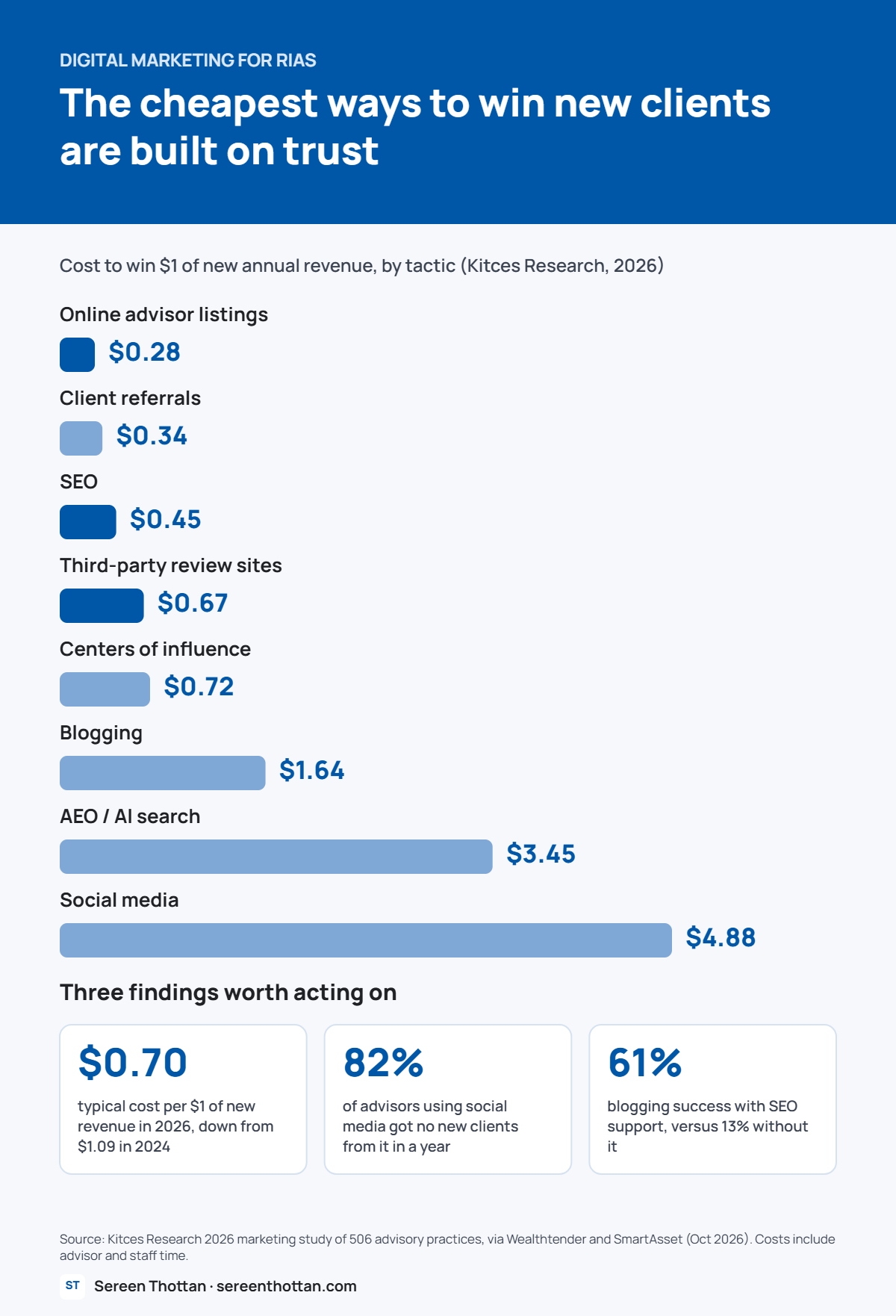
The best data on what works comes from the Kitces Research 2026 marketing study, which surveyed 506 advisory practices between March and April 2026 (summary via Wealthtender). It measures each tactic by its revenue acquisition cost: how much a firm spends, in dollars and staff time, to bring in $1 of new annual revenue.
- Advisors are getting more efficient. The typical practice spent $0.70 to win $1 of new revenue in 2026, down from $1.09 in 2024. The typical cost to acquire a client fell from $3,800 to $2,551.
- The cheapest channels are digital and trust-based. Online advisor listings cost $0.28 per $1 of new revenue, client referrals $0.34, SEO $0.45 and third-party review sites $0.67 (SmartAsset, citing Kitces).
- Social media is the least efficient tactic studied, at $4.88 per $1, and 82% of advisors using it reported zero new clients from it in the prior 12 months.
- SEO makes other content work. Blogging succeeded for 61% of advisors who also invested in SEO, versus 13% without it. For podcasts, the figures were 80% versus 43%.
- Answer engine optimization (AEO) is early. Only 10% of advisors use it so far, at a cost of $3.45 per $1 of new revenue, but they rate their satisfaction higher than SEO users do (5.1 versus 4.4 out of 10).
- Paid search is a known cost. Across US finance and insurance advertisers, Google Ads averaged $3.39 per click, a 2.64% conversion rate and $74.44 per lead (WordStream 2026 benchmarks). Advisor keywords usually cost more than the category average.
What is digital marketing for an RIA?
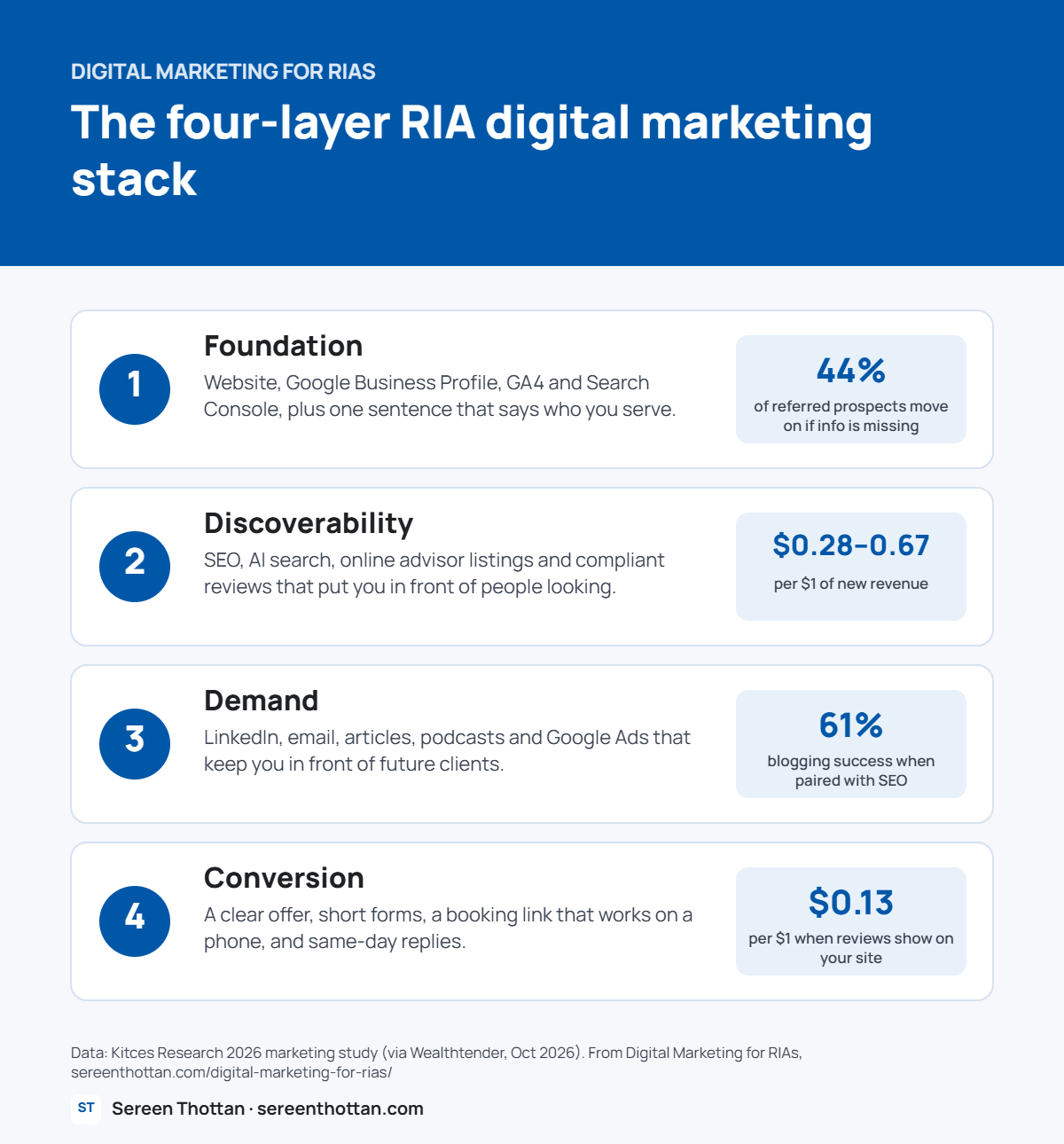
For an RIA, digital marketing is everything a prospect can find, read or interact with online before they talk to you. It covers four jobs:
- Foundation: a website, Google Business Profile and tracking that let prospects check you out and let you see what works.
- Discoverability: search, AI answers, directories and reviews that put your firm in front of people who are looking.
- Demand: LinkedIn, email, content and ads that keep you in front of people who aren’t looking yet.
- Conversion: offers, forms and booking links that turn interest into a first meeting.
Most RIAs still win most clients through referrals. Digital marketing doesn’t replace them. It makes sure a referred prospect who searches your name finds a firm worth calling, and it adds a second source of new clients that doesn’t depend on who your clients happen to know.
The RIA digital marketing channels, one by one
1. Your website
Everything else points here, so it has to do three things well: tell your ideal client in one sentence that you serve people like them, prove you’re credible (team bios, credentials, process, fees and minimums), and make the next step easy. Kitces cites research that 44% of referred prospects would move on if the information they wanted was missing. Your site should load fast on a phone, have one page per service and client type, and carry structured data for your firm, advisors and FAQs.
2. SEO
Search engine optimization is one of the most efficient channels advisors use, at $0.45 per $1 of new revenue, yet only 32% of advisors use it. It works best for focused firms: niche practices reported a 70% success rate with SEO in 2026, versus 42% for generalists. Target searches that combine your niche, your service and your location, such as “fee-only advisor for physicians in Dallas”. Our SEO for RIAs guide covers the five layers in detail, and our SEO service for wealth managers handles it end to end.
3. AI search visibility (AEO and GEO)
Prospects now ask ChatGPT, Gemini, Claude and Perplexity for advisor recommendations. Among advisors working on AEO, 72% focus on ChatGPT, 35% on Gemini, 30% on Claude and 20% on Perplexity. AI tools draw on the same signals as search, plus a clear description of who you serve and mentions on sites they already trust. The cost per dollar of revenue is still high because the channel is new, so treat it as a 12-month investment that compounds. See how ChatGPT decides which wealth manager to recommend, or check where you stand with a free AI Visibility Snapshot.
4. Google Business Profile and local search
For searches like “financial advisor near me”, Google shows a map with three firms before any website. A complete Google Business Profile with the right categories, photos, services and a steady flow of compliant reviews is the fastest local win. Keep your firm name, address and phone number identical on every site that lists you. More in our local SEO for RIAs service.
5. Online advisor directories
Listings were the single most efficient tactic in the 2026 study, at $0.28 per $1 of new revenue and a 79% success rate, with a typical annual fee of around $500. Only 18% of advisors use them. Choose directories your ideal clients actually use (fee-only networks, niche associations and vetted advisor marketplaces) and keep each profile as complete as your website.
6. Online reviews
Reviews were the fastest-growing tactic, with usage rising from 8% of advisors in 2024 to 13% in 2026, at $0.67 per $1 of new revenue. The striking finding: firms that display Google reviews on their own website saw that cost drop to $0.13, versus about $0.85 for firms that don’t. Reviews are allowed under the SEC Marketing Rule as testimonials, with disclosures and oversight, so agree on a process with your chief compliance officer before you ask clients for them.
7. LinkedIn and social media
Social media is the channel advisors use most after referrals and networking (36% of practices) and the least efficient, at $4.88 per $1 of new revenue. That doesn’t make LinkedIn useless. It means LinkedIn works best as a credibility channel: a complete advisor profile, regular posts that answer your ideal client’s questions, and links back to your website. It rarely works as a cold lead machine. Treat it as the place referred prospects and centers of influence check you out, and measure it on meetings, not likes. Our compliance-safe LinkedIn playbook for financial advisors walks through the rules and a six-step system.
8. Email and newsletters
Newsletter use declined between 2024 and 2026, but email remains the best way to stay in touch with prospects who aren’t ready yet and with the CPAs and estate attorneys who refer to you. One useful email a month, built from your articles, beats a weekly market recap. Segment by audience (clients, prospects, centers of influence) and send each a different call to action.
9. Content: blogging, podcasts and video
Content earns its keep when it is found. Blogging alone cost $1.64 per $1 of new revenue, but its success rate jumped from 13% to 61% when paired with SEO. Podcasts cost $0.82 per $1. Write and record around the specific questions your ideal client asks, publish on your own site first, then share on LinkedIn and email. One strong article a month is enough for most firms. Our content service for financial advisors handles the research, writing and compliance prep.
10. Google Ads
Paid search puts you in front of people searching right now. Across US finance and insurance, WordStream’s 2026 benchmarks show a $3.39 average cost per click, a 9.83% click-through rate, a 2.64% conversion rate and $74.44 per lead. Advisor and wealth keywords usually cost more, especially in large metros. Google Ads makes sense when you need inquiries quickly, have a landing page built for one audience and can track leads all the way to new clients. Sponsorships and paid advertising together cost $1.31 per $1 of new revenue in the Kitces data. See our Google Ads service for financial advisors.
RIA digital marketing channels compared
| Channel | Main job | Cost per $1 of new revenue (Kitces 2026) | Time to results |
|---|---|---|---|
| Online advisor listings | Be found by people comparing advisors | $0.28 | 1–3 months |
| SEO | Be found for niche and local searches | $0.45 | 3–6 months |
| Third-party reviews | Prove credibility | $0.67 ($0.13 when shown on your site) | 3–6 months |
| Podcasts | Show expertise at length | $0.82 | 6–12 months |
| Sponsorships and paid ads | Reach people searching now | $1.31 | Weeks |
| Blogging | Answer client questions; feed SEO and AI | $1.64 | 6–12 months |
| AEO / AI search | Be named in AI answers | $3.45 | 2–6 months |
| Social media | Credibility and relationships | $4.88 | 6–12 months |
Costs include the value of advisor and staff time, which is about 68% of what the typical practice spends on marketing. Your own numbers will differ, so track them.
How to choose your digital mix by firm stage
- Launching or breakaway RIAs: build the foundation first (website, Google Business Profile, tracking), then add directories and reviews for fast credibility. Make sure prospects can find you under your own name from day one. See website launch and SEO for breakaway advisors.
- Growing firms with steady referrals: add SEO built around your niche and one strong article a month. Use LinkedIn and email to stay in front of centers of influence. Start working on AI visibility.
- Established, multi-advisor firms: run SEO and AI search as an ongoing program, test Google Ads in your strongest markets, and build a reporting system that ties every channel to new clients and assets.
Whatever your stage, the Kitces data points the same way: high-growth firms design tactics that support each other (70% versus 44% of other firms) and track their prospects (37% versus 25%).
How to measure digital marketing for an RIA
Traffic and followers are easy to count and easy to misread. Measure the things that predict revenue:
- Qualified inquiries and booked first meetings, by source
- New clients and new assets, by source
- Cost per new client and cost per $1 of new revenue, by channel, including staff time
- Rankings for your 10–20 highest-intent searches
- Whether ChatGPT, Perplexity and Google’s AI Overviews name your firm for your key questions
Set up GA4 conversion events for every form and booking link, and add “How did you first hear about us, and where did you check us out?” to your intake form. Our analytics and lead tracking service sets this up, and Lead Generation for RIAs shows where each stage of the funnel tends to leak.
Keeping digital marketing compliant
SEC-registered advisers must follow the Marketing Rule across every channel: website pages, social posts, emails, ads and directory profiles. In practice:
- Educational content and clear descriptions of who you serve are quick to approve. Build most of your content around them.
- Reviews, testimonials and ratings are allowed with the required disclosures and oversight.
- Avoid performance claims in ads and posts unless your compliance team has signed off.
- Keep records of your advertisements and of business communications on every platform you use, including social media and messaging apps.
- Dual registrants should also check FINRA’s communications rules.
A 12-month digital marketing roadmap for an RIA
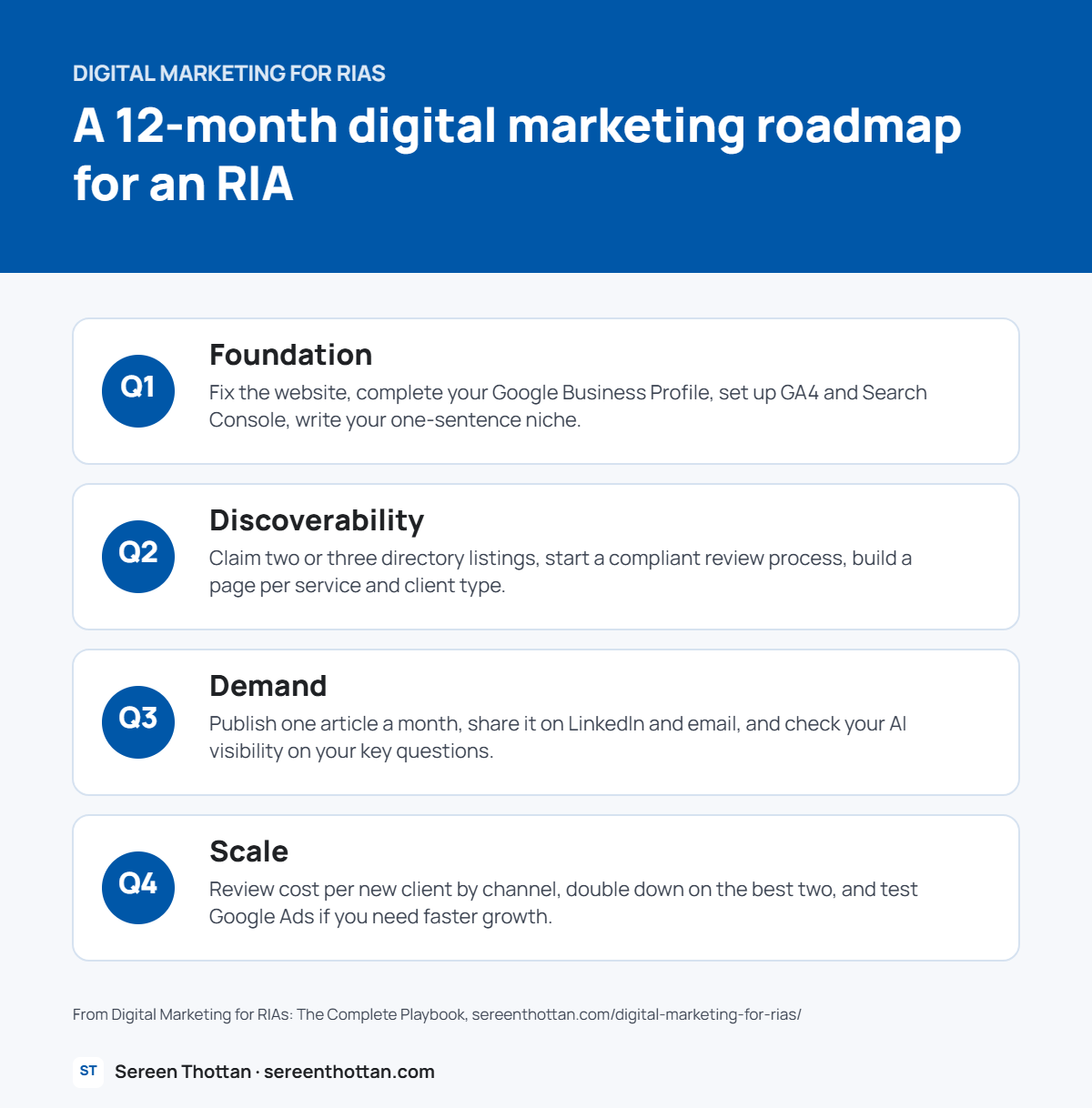
- Q1, foundation: fix the website, complete your Google Business Profile, set up GA4 and Search Console, and write your one-sentence niche.
- Q2, discoverability: claim two or three directory listings, start a compliant review process, and build pages for each service and client type.
- Q3, demand: publish one article a month, share it on LinkedIn and email, and run an AI visibility check on your key questions.
- Q4, scale: review cost per new client by channel, double down on the two best channels, and test Google Ads if you need faster growth.
Budgeting for this? See How Much Should an RIA Spend on Marketing in 2027?
Common digital marketing mistakes RIAs make
- Spreading thin. Five channels done halfway lose to two done well. Pick the channels that fit how your ideal client searches and commit for a year.
- Posting without a destination. LinkedIn posts and newsletters that never link back to a useful page on your site build someone else’s platform, not yours.
- Treating the website as a brochure. If a prospect can’t tell in five seconds who you serve, what it costs and how to book a call, every other channel loses value.
- Buying traffic before fixing conversion. Ads sent to a generic homepage waste budget. Build one landing page per audience first.
- Not counting staff time. Most marketing cost is advisor and staff time. A “free” channel that eats ten hours a week is expensive.
- Ignoring AI search. When ChatGPT names three firms in your city and yours isn’t one, you lose the prospect before they ever visit your site.
Go deeper
- Wealth Management Marketing: The 2027 Guide
- LinkedIn for Financial Advisors: A Compliance-Safe Playbook
- SEO for RIAs: A Practical Guide for Independent Wealth Firms
- Lead Generation for RIAs: From Google Search to Booked Meeting
- How Much Should an RIA Spend on Marketing in 2027?
- How ChatGPT Decides Which Wealth Manager to Recommend
Digital marketing for RIAs FAQ
What is the best digital marketing channel for an RIA?
For most firms it is a combination of SEO, online advisor listings and reviews. In the Kitces 2026 study these cost $0.28 to $0.67 to win $1 of new annual revenue, compared with $4.88 for social media. The best channel for you depends on your niche and how your ideal clients search.
Does LinkedIn work for financial advisors?
LinkedIn works best as a credibility channel rather than a lead generator. Kitces found social media was the least efficient tactic studied, and 82% of advisors using it reported no new clients from it in the past year. Use it to support referrals and centers of influence, and link posts back to your website.
How much do Google Ads cost for financial advisors?
WordStream’s 2026 benchmarks put the US finance and insurance average at $3.39 per click and $74.44 per lead. Advisor and wealth management keywords usually cost more, especially in large metros, so judge results on cost per new client rather than cost per click.
Should an RIA invest in AI search optimization?
Yes, as a long-term investment. Only about 10% of advisors work on AEO today, and it costs more per dollar of revenue than SEO for now, but satisfaction is higher. Most of what helps AI tools recommend your firm also strengthens your SEO.
How long does digital marketing take to work for an RIA?
Directory listings and Google Ads can produce inquiries within weeks. SEO, reviews and AI visibility usually take three to six months, and content builds over six to 12 months. Plan for a year and review cost per new client every quarter.
Want a digital marketing plan built around your niche? Book a 30-minute strategy call and we’ll review your website, search and AI visibility, and the channels most likely to bring you clients. Book a call →
This article is for general information and isn’t legal or compliance advice. Confirm any marketing changes with your CCO.