Wealth management marketing is how a wealth firm gets chosen by the clients it wants: it decides who the firm serves, makes sure those people can find and check the firm (on Google, in Google Maps and now in AI tools like ChatGPT), and turns that interest into first meetings. In 2027 the firms that grow will be the ones that plan this on purpose, because referrals alone no longer fill the pipeline and more of every prospect’s research now happens before they ever call.
This guide is for founders, managing partners and marketing leads at independent RIAs, boutique wealth managers and family offices in the US. It covers how high-net-worth clients actually find an advisor today, a five-part framework for marketing a wealth firm, which channels are worth your time, what the SEC Marketing Rule allows, what to budget, and a 90-day plan you can start this quarter.
Wealth management marketing in 2027: the numbers that matter
- Organic growth has stalled. Kitces Research found the mean organic growth rate of RIAs fell to 3% in 2026, from 9% nine years earlier (Financial Planning).
- Planning pays. Schwab’s 2026 RIA Benchmarking Study found firms with an ideal client persona, a client value proposition and a written marketing plan added 87% more new clients and 127% more new client assets in 2025 than other firms (Schwab).
- Wealthy clients are less referral-dependent than advisors think. Among investors with $5 million or more, 50% found their current advisor without any referral (Ficomm Partners and Absolute Engagement, via InvestmentNews).
- AI is already part of the search. In the same survey, about 9% of investors used an AI tool such as ChatGPT, Gemini or Claude to find their advisor, rising to 25% of those under 45.
- The typical firm spends about 7% of revenue on marketing, most of it advisor and staff time rather than hard costs (Kitces Research via Family Wealth Report).
- The prize is large. Cerulli projects $124 trillion in US wealth will change hands through 2048, $105 trillion of it to heirs (Cerulli Associates). Most of those heirs will research a new advisor online before they meet one.
What is wealth management marketing?
Wealth management marketing is every activity that helps a wealth firm attract, earn the trust of and win the clients it is built to serve. It includes positioning (who you serve and why you), visibility (search, AI answers, events, partners), credibility (your website, content, reviews and people) and conversion (how a curious prospect becomes a booked meeting).
It differs from marketing most other services in three ways. The sale is large and slow: a prospect may research for months before reaching out. Trust is the product: nobody hands over $3 million because of a clever ad. And it is regulated: SEC-registered advisers must follow the Marketing Rule in everything they publish. Good wealth management marketing works with all three, not against them.
How high-net-worth clients find a wealth manager now
Referrals still matter most, but they no longer work alone. In the Kitces 2026 marketing study, about 43% of consumers found their advisor through friends and family, about a quarter through events or networking, about 20% through a trusted third party such as an attorney or CPA, and about 4% through a search engine or AI (InvestmentNews). Kitces noted that even 4% equals roughly a million consumers a year.
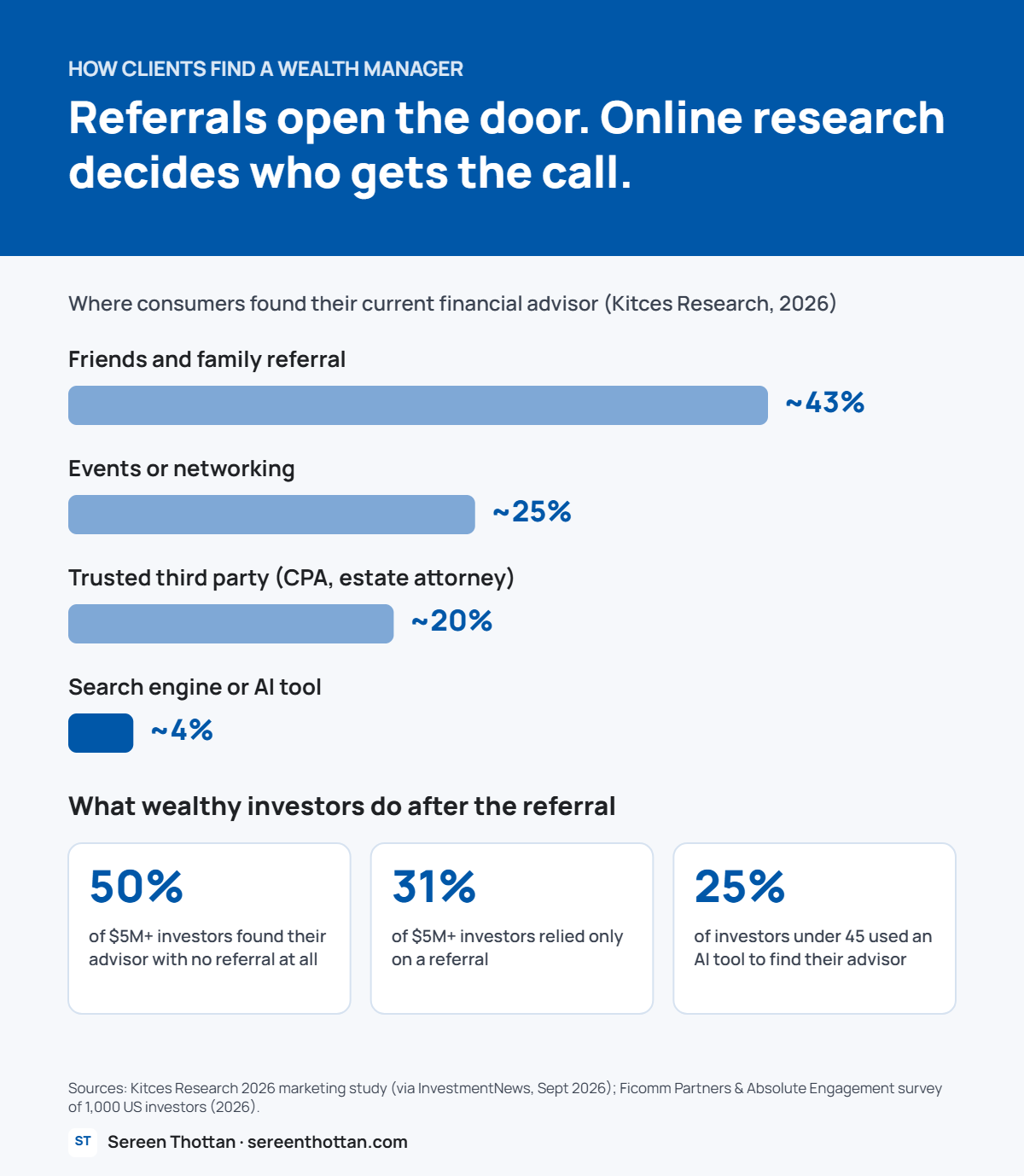
The bigger shift is what happens after the referral. A name from a friend starts a due-diligence process. The prospect Googles the firm, reads the website, checks the advisor on LinkedIn and, increasingly, asks an AI tool how you compare. Among $5 million-plus investors, only 31% relied exclusively on a referral; for investors under 45, that fell to 8%. Nearly 74% said it was very important that an advisor understood their specific needs.
So the job of marketing in 2027 is two-fold: be found by the people who don’t have a referral, and be convincing to the people who do. A firm that is invisible or generic online loses both.
AI tools add a new wrinkle. When someone asks ChatGPT for “the best fee-only advisor in Seattle for a tech executive”, it names a short list of firms and explains why. Being on that list depends on how clearly your firm describes who it serves and how often trusted sources mention you. We cover the mechanics in How ChatGPT Decides Which Wealth Manager to Recommend.
The five-part framework for marketing a wealth firm
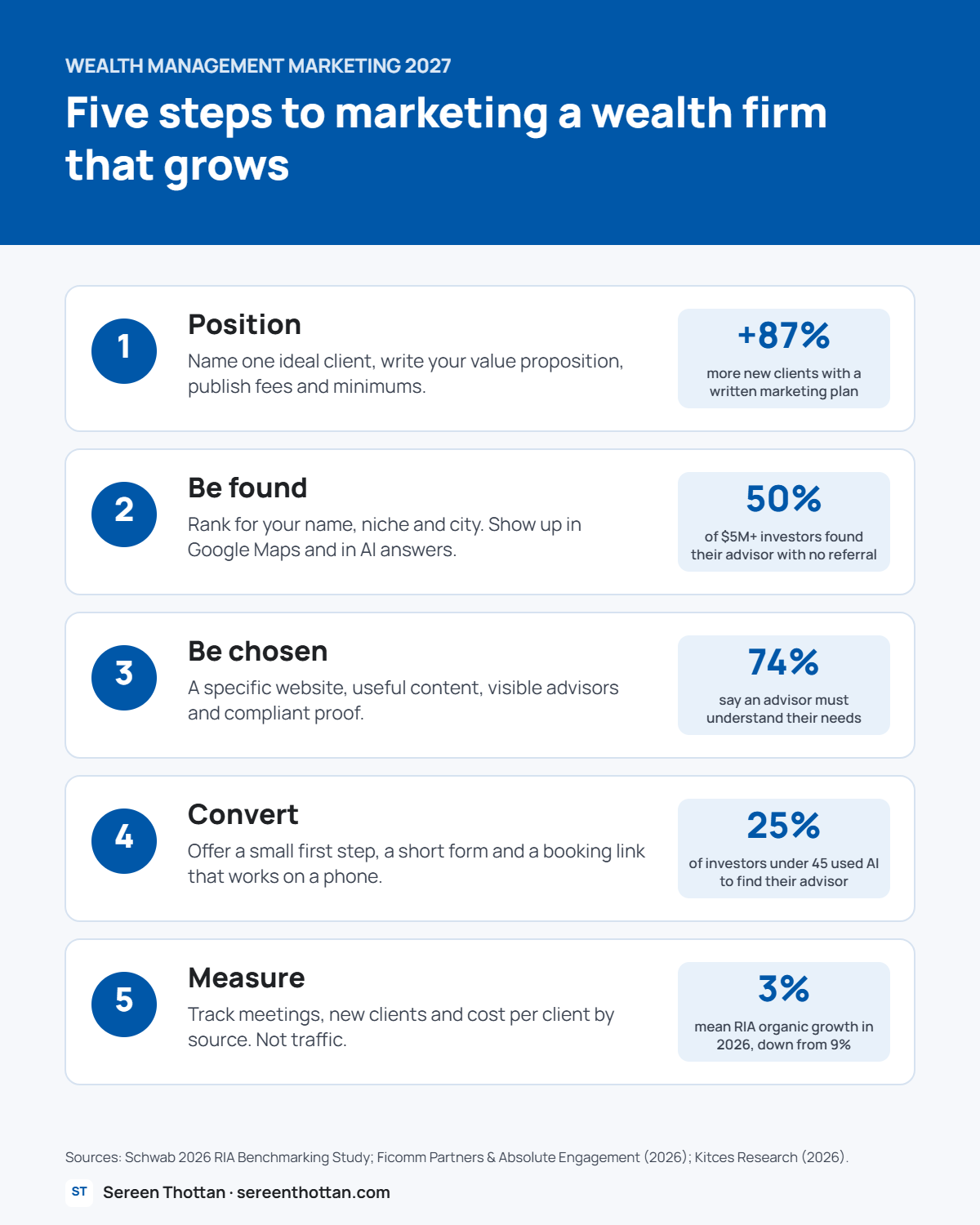
Most firms try tactics first: a newsletter, a LinkedIn push, a website refresh. The firms that grow work in order. Each step makes the next one cheaper.
1. Position: decide exactly who you serve
Positioning is the cheapest growth lever you have. A firm that serves “high-net-worth individuals and families” competes with every other firm in its city. A firm that serves “tech executives with concentrated stock in the Seattle area” or “physicians within ten years of retirement” competes with very few, and is far easier for prospects, referrers and AI tools to remember.
The data backs this up. Kitces found that niche firms, where one target market accounts for at least 75% of new clients, are overrepresented among high-growth practices. Schwab’s top-performing firms consistently document three things: an ideal client persona, a client value proposition and a written marketing plan.
Michael Kitces made the point memorably at his 2026 Marketing Summit: a homepage that lists every possible client type makes prospects see how many others are listed who are not like them. Pick a primary audience and say it in your first sentence.
Write down, on one page:
- Your ideal client: occupation or life stage, typical investable assets, location, the problem that makes them look for help
- Your value proposition: what you do for that client that others don’t, in their words
- Your minimums and fee approach, stated plainly (Kitces suggests publishing them so clients can refer without an awkward money conversation)
- The three questions your ideal client asks before hiring anyone
Those three questions become your website copy, your content plan and your AI search targets.
2. Be found: show up where prospects look
Being found now means four places, in this order of importance for most firms:
- Google search for your name, your niche and your city. Your site should rank first for your firm name and advisor names, and you should have a page for each service and client type. Start with SEO for RIAs: A Practical Guide.
- Google Maps and local results for searches like “fee-only financial advisor near me”. A complete, accurate Google Business Profile is the fastest win in local search. See local SEO for RIAs.
- AI answers in ChatGPT, Perplexity and Google’s AI Overviews. These tools draw on the same signals as search, plus clear “who we serve” statements, structured data and third-party mentions. This is generative engine optimization (GEO).
- Trusted third parties: CPAs, estate attorneys, industry directories, podcasts and trade press. These are both a referral channel and the citations AI tools rely on.
3. Be chosen: give prospects a reason to trust you
Once a prospect finds you, they decide in minutes whether you are worth a call. Four things do most of the work:
- A specific website. Your homepage names your ideal client, your services are on separate pages, your team bios carry credentials, and your process, fees and minimums are easy to find.
- Educational content that answers your ideal client’s real questions. One useful article a month beats four generic ones. It also gives AI tools something to quote.
- Visible expertise. Advisors who post consistently on LinkedIn, speak on podcasts or write for trade publications build trust before the first meeting.
- Proof, used carefully. Client testimonials and third-party ratings are now allowed under the SEC Marketing Rule, with disclosures and oversight. More on that below.
4. Convert: make the next step easy
Most wealth firm websites have one call to action: “Contact us”. That asks a prospect to commit before they are ready. Better funnels offer a small, useful first step, such as a short guide, a second-opinion review or a planning checklist, then a clear way to book a call. Every form should be short, every booking link should work on a phone, and every inquiry should get a same-day reply. We break this down step by step in Lead Generation for RIAs: From Google Search to Booked Meeting.
5. Measure: track meetings, not traffic
Website visits are a weak goal. Track the numbers that predict revenue: qualified inquiries, first meetings, new clients and assets, and where each one came from. Add one question to your intake form (“How did you first hear about us, and where did you check us out?”) and you will learn more than most analytics dashboards tell you. Then track your cost to acquire each client by channel.
Which marketing channels work for wealth managers?
No single channel wins for every firm. The right mix depends on your niche, your stage and how much advisor time you can give. Here is how the main options compare.
| Channel | Best for | Time to results | Advisor time needed |
|---|---|---|---|
| Client referrals with a referral plan | Every firm | Ongoing | Medium |
| CPA and attorney partnerships | Firms with a clear niche | 3–12 months | High |
| SEO and local search | Firms that want steady inbound leads | 3–6 months | Low |
| AI search visibility (GEO) | Firms whose clients research online | 2–6 months | Low |
| Educational content and email | Niche firms with a clear point of view | 6–12 months | Medium |
| LinkedIn and social media | Advisors willing to post consistently | 3–9 months | High |
| Events and seminars | Local firms with a defined community | Immediate to 6 months | High |
| Google Ads | Firms that need leads quickly | Weeks | Low |
Kitces research has long shown that tactics needing a lot of advisor time stop scaling as a firm grows, while tactics that run without advisors, such as search, content and online listings, get more efficient over time. A growing firm should shift its mix in that direction each year. A full channel-by-channel playbook is coming in our guide to digital marketing for RIAs.
Wealth management marketing and the SEC Marketing Rule
The SEC’s Marketing Rule (Rule 206(4)-1), adopted in December 2020 with a compliance date of November 4, 2022, governs advertisements by SEC-registered investment advisers. For marketing, five points matter most:
- Testimonials and endorsements are allowed, as long as you meet the rule’s disclosure, oversight and disqualification conditions. That includes clear statements about whether the person is a client and whether they were paid.
- Third-party ratings are allowed with disclosures about who created the rating and the period it covers.
- Every material claim must be substantiated. If you say you are “the leading” anything, you need proof on file.
- Performance claims carry the heaviest requirements. Most firm websites and articles are better without them.
- Keep records of advertisements and the support for what they say.
The practical takeaway: educational content, clear descriptions of who you serve, and team expertise are quick to approve. Build your marketing around them, and bring your chief compliance officer in early on reviews, testimonials and anything that mentions results. The SEC’s small entity compliance guide is the best plain-English starting point.
How much should a wealth management firm spend on marketing?
Start from your growth goal, not an industry average. The Kitces figure of about 7% of revenue is a useful reference, but most of that is the cost of advisor and staff time. Only around 2% of marketing spend typically goes on hard costs such as software and listings. If your advisors are the main marketing engine, the real constraint is their calendar.
A simple rule: the more of your growth you want to come from people who don’t already know you, the more you should invest in channels that work without advisors in the room. We walk through budgets by firm size and growth goal in How Much Should an RIA Spend on Marketing in 2027?
Marketing for different kinds of wealth firms
- Independent RIAs win with a sharp niche, strong local search and educational content that answers their ideal client’s questions.
- Single and multi-family offices need discretion more than reach. Marketing is about being findable and credible to the small number of families who are looking, and invisible to everyone else. See Family Office Marketing: How to Be Found by the Right Families.
- Merging and acquiring firms must protect the search visibility both firms earned before they change names, domains or websites. Use our RIA merger website migration checklist.
- Breakaway advisors need to be findable under their own name from day one. See website launch and SEO for breakaway advisors.
A 90-day wealth management marketing plan
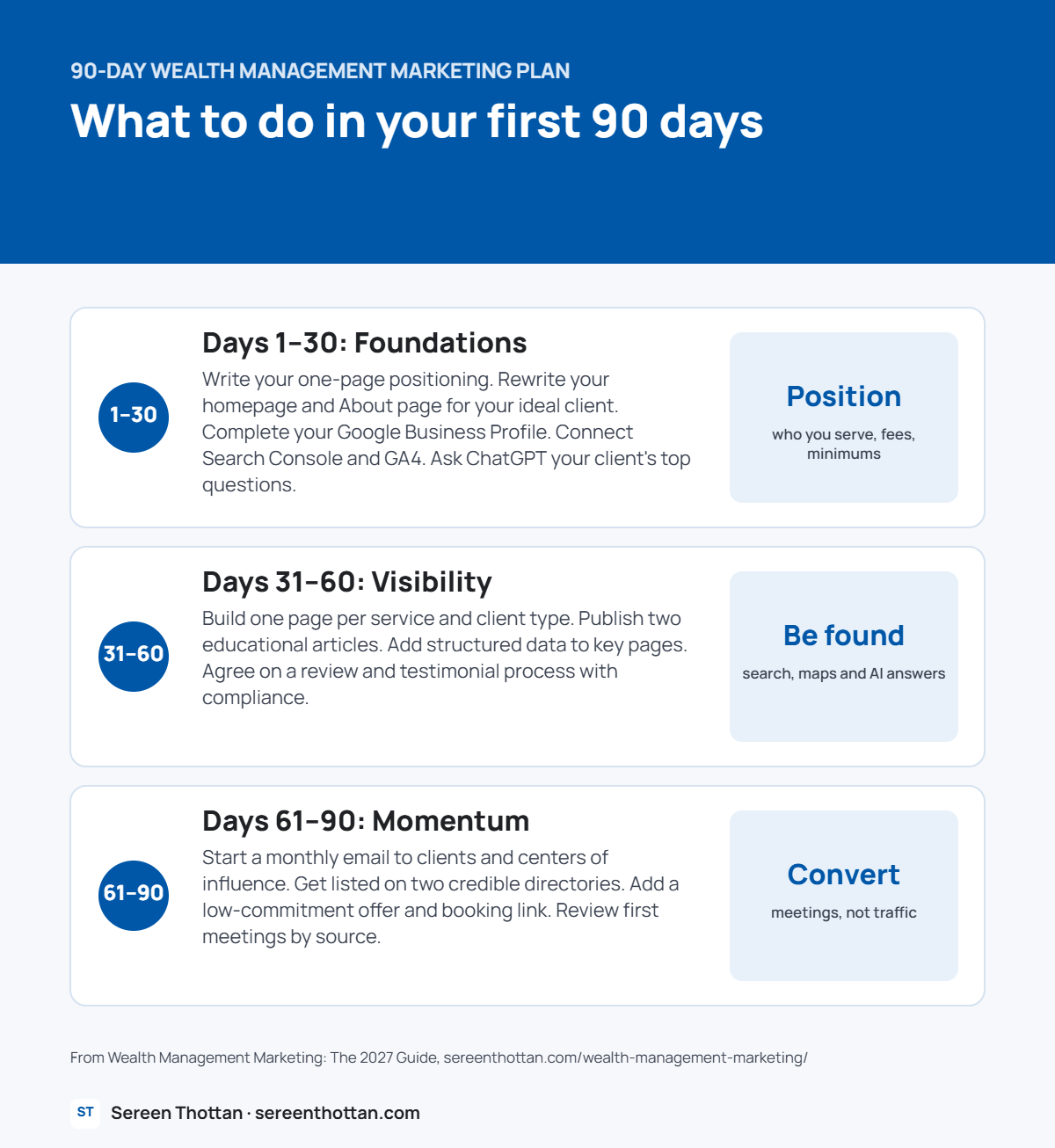
Days 1–30: foundations.
- Write your one-page positioning: ideal client, value proposition, fees and minimums, top three client questions
- Rewrite your homepage headline and About page around that client
- Claim and complete your Google Business Profile; make your name, address and phone number identical everywhere
- Connect Google Search Console and Google Analytics, and add a “how did you hear about us?” question to your intake form
- Ask ChatGPT, Perplexity and Google your ideal client’s top three questions and note who gets named
Days 31–60: visibility.
- Build one page per service and per client type
- Publish two educational articles that answer your ideal client’s questions, each linking to a service page
- Add structured data (organization, advisors, FAQs) to your key pages
- Agree a review and testimonial process with compliance
Days 61–90: momentum.
- Start a monthly email to clients and centers of influence, built from your articles
- Get listed on two or three credible industry directories and pitch one podcast or trade publication
- Add a low-commitment offer and a simple booking link to every page
- Review first meetings by source and decide where to put next quarter’s time and money
Common wealth management marketing mistakes
- Marketing to everyone. Generic positioning makes every other channel more expensive.
- A website that talks about the firm, not the client. “We are a fiduciary committed to excellence” says nothing a prospect can use.
- Assuming referrals don’t check you online. They do, and a weak website or empty search result costs you meetings you never hear about.
- Ignoring AI search. When a prospect asks ChatGPT for a recommendation and you aren’t named, you aren’t in the running.
- Measuring traffic instead of meetings. A popular article that brings no qualified inquiries is a hobby, not marketing.
- Letting compliance become the excuse. Educational content is quick to approve. Plan around it.
What’s next: original data on AI recommendations
In March 2027 we will publish a study of which wealth firms AI tools recommend, built from hundreds of AI Visibility Snapshots run for US firms. It will show which signals separate firms that get named from those that don’t. This guide will be updated with the findings.
Go deeper
- How ChatGPT Decides Which Wealth Manager to Recommend
- Family Office Marketing: How to Be Found by the Right Families
- Merging Firms? The RIA Website Migration Checklist
- SEO for RIAs: A Practical Guide for Independent Wealth Firms
- Lead Generation for RIAs: From Google Search to Booked Meeting
- How Much Should an RIA Spend on Marketing in 2027?
Wealth management marketing FAQ
What is the best marketing strategy for a wealth management firm?
The best strategy starts with a clear niche and a documented ideal client, then builds visibility (search, AI answers, partners) and credibility (website, content, people) around that client. Schwab’s 2026 study found firms with a persona, value proposition and written marketing plan added 87% more new clients than other firms.
How do wealth managers attract high-net-worth clients?
Mostly through trust: referrals, centers of influence, visible expertise and a website that speaks directly to the client’s situation. Half of $5 million-plus investors found their advisor without a referral, so being easy to find and check online matters as much as the referral itself.
Does SEO work for wealth management firms?
Yes, especially for searches that combine a niche, a service and a location. It also supports referrals, because most referred prospects search your name before they call.
Do wealth managers need to worry about AI search?
Yes. About 9% of investors already use AI tools to find an advisor, and 25% of those under 45 do. AI tools favor firms that describe their clients clearly, use structured data and are mentioned by trusted third parties.
Can wealth managers use client testimonials?
Yes. Since the SEC Marketing Rule took effect in November 2022, SEC-registered advisers can use testimonials and endorsements with the required disclosures, oversight and recordkeeping. Agree a process with your compliance officer first.
Is your firm in the AI answer? Get a free AI Visibility Snapshot and see whether ChatGPT, Perplexity and Google’s AI Overviews name your firm, and who they name instead. Get my Snapshot →
This article is for general information and isn’t legal or compliance advice. Confirm any marketing changes with your CCO.